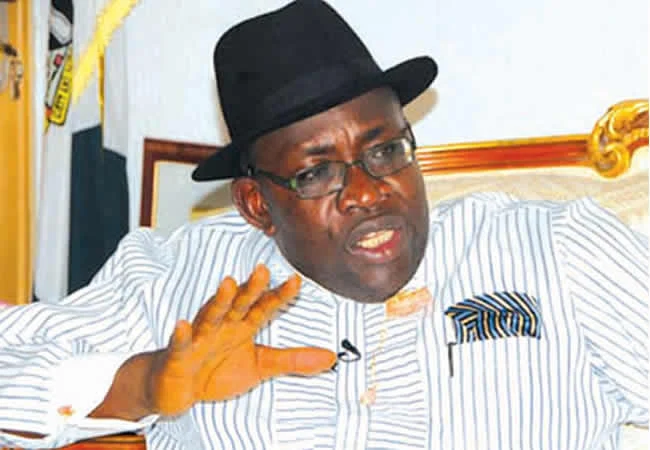
A former Bayelsa State governor and lawmaker representing Bayelsa West, Senator Seriake Dickson, has said Nigeria is not yet at the stage of electronic voting, describing the insistence on “real-time” transmission of election results as unnecessary.
Speaking in an interview with ARISE News on Tuesday, he said the concept of real-time transmission is being widely misunderstood.
“What is the meaning of real time? We are not voting electronically in Nigeria. We are not at the point where you go and press a button and your vote is instantly added to a portal,” he said.
He described the term as “superfluous,” adding that it does not in itself guarantee transparency.
“The word ‘real time’ in this context is actually superfluous. It doesn’t, on its own, give you a transparent election. It shouldn’t have been there in the first place. It’s never too late to correct something.”
He further added that the Senate’s latest action on the Electoral Act Amendment Bill should not be seen as a setback for democracy.
“I don’t count the proceedings of today and the outcome as a loss for democracy,” he said.
His comments come in the wake of the Senate’s emergency plenary, which revisited Clause 60(3) of the bill following public outrage. The upper chamber approved the transmission of results to the Independent National Electoral Commission’s Result Viewing Portal (IREV), while retaining manual collation as a backup in cases of network failure. However, the Senate stopped short of making electronic transmission compulsory and rejected the inclusion of real-time upload of results.
Critics have argued that the absence of an explicit real-time transmission requirement leaves room for manipulation.
Dickson, however, clarified that he was speaking in his personal capacity.
“I’m not here as spokesman of the Senate. I’m here to give my views as someone who has been deeply involved in all these processes as a ranking member of this committee and as someone who participated in the proceedings of today,” he said.
He explained that deliberations on electronic transmission had lasted nearly two years, involving consultations and engagements with INEC.
“This has been going on for about two years or so — different workshops, conferences at the Senate Committee, joint committees and also interactions with INEC,” he said.
The senator disclosed that he was absent when the Senate earlier took the controversial decision due to bereavement.
“I was not there when the Senate took that decision earlier, about a week ago, as I was bereaved. I lost a close brother, the sitting deputy governor of my state. Today was the very first day I went to sit in the Senate because of the importance of this matter,” he said.
Tracing resistance to electronic transmission to longstanding political divisions, Dickson said, “This issue of electronic transmission is always problematic. Even in the 9th Senate, when we tried to introduce electronic transfer, there was stiff opposition. Somehow, the party in power has always been very resistant to these notions.”
Leave a Reply